
Showing posts with label General Management. Show all posts

Wednesday, March 28, 2018

Outsourcing

This era is the era of outsourcing. The move to offshore work to take advantage of low cost labor is affecting every area of outsourcing. Every company needing applications will have to outsource or create its own offshore captive if it is going to have the work done cost effectively. Last year offshore service providers moved from project work to true outsourcing. Now that they have earned the respect of their buyers, the offshore suppliers are entering into long-term outsourcing relationships. Substantial migration of SAP R/3 support work to India is expected in the near future.
Appropriate support model needs to be developed for each engagement depending of the client’s organization, supporting organization. Many cultural issues need to be addressed. Communication channels need to be developed.
Mr. Karkhanis is a very senior SAP R/3 consultant having 10 years of SAP R/3 implementation and production support experience with big consulting firms. He has implemented SAP R/3 in USA, Australia, Hong Kong, China, India and many other countries. Currently he is working on developing and stabilizing SAP R/3 offshore development models for many big accounts. The organizations to be supported are big multinationals having offices in many countries across the world. The support is being managed from India and other countries by mainly Indian software firms.
Mr. Karkhanis is offering support to Developing onsite/offshore production support model for supporting SAP R/3 and other ERP packages. He is available on job-work as well as on retainer basis. He is expert in developing solutions for such assignments.
If your organization is looking for a support partner from India or other countries, Mr. Karkhanis will assist you in selecting the partner. If you are looking for engagement with an organization for giving offshore production support. Mr. Karkhanis can assist you in pre-sales discussions, developing appropriate solution and support organization as well as providing technical support.
You may contact him at santosh@karkhanisgroup.com


Continuous Quality Improvement Techniques

This paper is designed to help you & every person in your organization to daily improve the procedures, systems, quality cost and yields related to your job. This will help in QUALITY REVOLUTION in your organization.

We believe

  • That improving quality by removing the causes of problems in the system inevitably leads to improved productivity.
  • That the person doing the job is most knowledgeable about that job.
  • That people want to be involved and do their jobs well.
  • That every person wants to feel like a valued contributor.
  • That more can be accomplished working together to improve the system than having individual contributors working around the system,
  • That a structured problem solving process using graphical techniques produces better solutions than in ',an unstructured process.
  • That graphical problem solving techniques let you know where you are, where the variations lie, the relative importance of problems to be solved and whether the changes made have had the desired impact.
Techniques Solution Guide


  1. To decide which problem will be addressed first (or next)
ü Flow Chart
ü Check Sheet
ü Pareto Chart
ü Brainstorming
ü Nominal Group Technique
  1. To arrive at a statement that describes the problem in terms of what it is specifically, where it occurs, when it happens, and its extent
ü Check Sheet
ü Pareto Chart
ü Run Chart
ü Histogram
ü Pie Chart
ü Stratification
  1. To develop a complete picture of all the possible causes of the problem
ü Check Sheet
ü Cause & Effect Diagram
ü Brainstorming
  1. To agree on the basic cause(s) of the problem
ü Check sheet
ü Pareto Chart
ü Scatter Diagram
ü Brainstorming
ü Nominal! Croup Technique
  1. To develop an effective and solution and action plan, which can be implemented
ü Brainstorming
ü Force Field Analysis
ü Management Presentation
ü Pie Chart
ü Additional Bar Graphs
  1. To implement the solution and establish needed monitoring procedures and charts
ü Pareto Chart
ü Histogram
ü Control Charts
ü Process Capability;
ü Stratification

If you wish to implement 'Continuous Quality Improvement Strategy' in your organization, Contact Mr. Santosh Karkhanis.

Strategic Planning

What is strategic planning?

Entrepreneurs and business managers are often so preoccupied with immediate issues that they lose sight of their ultimate objectives. That's why a business review or preparation of a strategic plan is a virtual necessity

A strategy is an overall approach and plan. Strategy is the framework of choices that determine the nature and direction of an organization. So, strategic planning is the overall planning that facilitates the good management of a process. Strategic planning takes you outside the day-to-day activities of your organization or project. It provides you with the big picture of what you are doing and where you are going. Strategic planning gives you clarity about what you actually want to achieve and how to go about achieving it, rather than a plan of action for day-to-day operations.

A strategic plan should:
  • Serve as a framework for decisions or for securing support/approval.
  • Provide a basis for more detailed planning.
  • Explain the business to others in order to inform, motivate & involve.
  • Assist benchmarking & performance monitoring.
  • Stimulate change and become building block for next plan.

Strategic planning enables you to answer the following questions:
  • Who are we?
  • What capacity do we have/what can we do?
  • What problems are we addressing?
  • What difference do we want to make?
  • Which critical issues must we respond to?
  • Where should we allocate our resources?/what should our priorities be?

Only once these questions are answered, is it possible to answer the following:
  • What should our immediate objective be?
  • How should we organize ourselves to achieve this objective?
  • Who will do what when?

A strategic plan is not rigid. It does, however, give you parameters within which to work. That
is why it is important to:


  • Base your strategic planning process on a real understanding of the external environment
  • Use work you have already done to extend your understanding of the external environment and of your own capacity, strengths and weaknesses

A strategic plan should not be confused with a business plan. The former is likely to be a (very) short document whereas a business plan is usually a much more substantial and detailed document. A strategic plan can provide the foundation and frame work for a business plan.

A strategic plan is not the same thing as an operational plan. The former should be visionary, conceptual and directional in contrast to an operational plan which is likely to be shorter term, tactical, focused, implementable and measurable.

Why do people fail to delegate?

Why do people fail to delegate?

  • Lack of Time
  • Perfectionism – fear of mistakes
  • Enjoying : ‘Getting my hands dirty’
  • Fear of surrendering authority
  • Fear of becoming invisible
  • Belief that staff are not up to the job


When to Delegate

  • Is there any subordinate who has ability to do the task?
  • Does the task provide opportunity to enhance your subordinate’s skills?
  • Is there possibility to recur the task in similar form?
  • Do you have sufficient time to explain / train your subordinate?
  • Is the task very critical for your long term success? Would the failure be crucial?
  • Is the task on critical path? Do you have sufficient slack time to repair / redo, if not done properly?

Whom to Delegate
  • Knowledge, Experience & Skills
  • Does the person have sufficient knowledge, experience & skills?
  • Do you sufficient time to impart the skills needed?
  • The individual’s preferred work style
  • How independent is the person?
  • What does he want from his job?
  • What are his long term personal goals & how are they aligned with the task to be delegated?
  • The current workload on the person
  • Does the person has time to take more workload?
  • Will the delegation process needs reshuffling of his other responsibilities or workload?

How to Delegate

  • Do not avoid delegating something because you cannot give someone the entire project. Let the person start with a bite size piece, then after learning and doing that, they can accept larger pieces and larger areas of responsibility. Break large jobs into manageable pieces and delegate pieces to those who can do them more readily.
  • Find out what the talents and interests of your people are and you will be able to delegate more intelligently and effectively.
  • Clearly articulate the desired outcome. Begin with the end in mind and specify the desired results.
  • Clearly identify constraints and boundaries. Where are the lines of authority, responsibility and accountability? Should the person:
    • Wait to be told what to do?
    • Ask what to do?
    • Recommend what should be done, and then act?
    • Act, and then report results immediately?
    • Initiate action, and then report periodically?
  • Where possible, include people in the delegation process. Empower them to decide what tasks are to be delegated to them and when.
  • Match the amount of responsibility with the amount of authority. Understand that you can delegate some responsibility, however you can’t delegate away ultimate accountability. The buck stops with you!
  • Delegate to the lowest possible organizational level. The people who are closest to the work are best suited for the task, because they have the most intimate knowledge of the detail of everyday work. This also increases workplace efficiency, and helps to develop people.
  • Provide adequate support, and be available to answer questions. Ensure the project’s success through ongoing communication and monitoring as well as provision of resources and credit.
  • Focus on results. Concern yourself with what is accomplished, rather than detailing how the work should be done: Your way is not necessarily the only or even the best way! Allow the person to control his or her own methods and processes. This facilitates success and trust.
  • Avoid “upward delegation”. If there is a problem, don’t allow the person to shift responsibility for the task back to you: ask for recommended solutions; and don’t simply provide an answer.
  • Build motivation and commitment. Discuss how success will impact financial rewards, future opportunities, informal recognition, and other desirable consequences. Provide recognition where deserved.
  • Establish and maintain control.
    • Discuss timelines and deadlines.delegating correctly, you will find that he or she quickly becomes competent and reliable.
    • Agree on a schedule of checkpoints at which you’ll review project progress.
    • Make adjustments as necessary.
    • Take time to review all submitted work.
  • Never take back a delegated item because you can do it better or faster. Help the other person learn to do it better.
  • Delegation strengthens your position. It shows you are doing your job as a manager-getting results with others. This makes you more promotable.
  • A person will be more excited about doing a project when they came up with the idea of how to do it, than if the boss tells them how to do it.
  • Be sensitive to upward delegation by your staff. When they ask you for a decision on their project, ask them to think about some alternatives which you will then discuss with them. This way responsibility for action stays with the staff member.
  • Resist the urge to solve someone else's problem. They need to learn for themselves. Give them suggestions and perhaps limits but let them take their own action


Keeping Control

  • The most difficult act in delegating process.
  • Macro-control is necessary & not micro-control
  • Give sufficient space to people to use their full abilities, but keep watch to ensure that the job is done correctly & timely.

Full Acceptance of the Work
  • Review the full delegated work after completion.
  • Compliment for the good work /qualities you have observed in the work. This will boost moral of the people & they will be psychologically ready to accept more difficult challenges.
  • Tell the areas of improvement, so next time they can do better job.
  • This way self confidence & efficiency both will improve in the next delegated work & this is win-win situation for both,

SMARTER Rule for Delegation
  • Specific
  • Measurable
  • Agreed
  • Realistic
  • Time bound
  • Ethical
  • Recorded

Steps for successful delegation
  • Define the task
  • Select the individual or team
  • Assess ability and training needs
  • Explain the reasons
  • State required results
  • Consider resources required
  • Agree deadlines
  • Support and communicate
  • Feedback on result

Levels of Delegation

  • Level 1 : Work as per instructions. No delegated freedom to the way of working.
    e.g. “Wait to be told”, Do exactly as I say”, Follow the instructions precisely”
  • Level 2 : Asking for investigation and analysis but no recommendation. The person delegating retains responsibility for assessing options prior to making the decision.
    e.g. "Look into this and tell me the situation. I'll decide."
  • Level 3 : encourage and enable the analysis and decision to be a shared process, which can be very helpful in coaching and development.
    e.g. "Look into this and tell me the situation. We'll decide together."
  • Level 4 : Possibility of greater freedom for analysis and decision-making, subject to both people agreeing this is appropriate. Again, this level is helpful in growing and defining coaching and development relationships.
    e.g. "Tell me the situation and what help you need from me in assessing and handling it. Then we'll decide."
  • Level 5 : Ask for analysis and recommendation, but you will check the thinking before deciding.
    e.g. "Give me your analysis of the situation (reasons, options, pros and cons) and recommendation. I'll let you know whether you can go ahead."
  • Level 6 : Trusted to assess the situation and options and is probably competent enough to decide and implement too, but for reasons of task importance, or competence, or perhaps externally changing factors, the boss prefers to keep control of timing.
    e.g. "Decide and let me know your decision, and wait for my go-ahead before proceeding."
  • Level 7 : Give control of the action. But still keeping an eye.
    e.g. "Decide and let me know your decision, then go ahead unless I say not to."
  • Level 8 : Gives more freedom to act. But still some sort of coaching is involved.
    e.g. "Decide and take action - let me know what you did (and what happened)."
  • • Level 9 : Higher level of control. Shows confidence.
    e.g. "Decide and take action. You need not check back with me."
  • Level 10 : Gives all the responsibility.
    e.g. "Decide where action needs to be taken and manage the situation accordingly. It's your area of responsibility now."

Psychological Contracts, Emotional Contracts
When you are delegating responsibility, there is some kind of agreement of getting the job done up to satisfaction. Unless such kind of agreement, delegation is not possible. Such agreement is sometimes implicit or some times explicit.


References
1. http://www.businessballs.com/delegation.htm
2. http://www.mindtools.com/pages/article/newLDR_98.htm
3. http://www.training-manager.co.uk/documents/DelegationSkills.pdf
4. http://www.bizmove.com/skills/m8q.htm
5. http://ezinearticles.com/?Effective-Delegation-Skills-For-Managers&id=1681642

Delegation and Control

Derived from Latin, delegate means "to send from." When delegating you are sending the work "from" you "to" someone else. Effective delegation Skills will not only give you more time to work on your important opportunities, but
you will also help others on your team learn new skills. Here are some tips that will help you improve your delegation skills - delegation of work .

If you work on your own, there’s only a limited amount that you can do, however hard you work. You have to take help of a number of people. If you take help smaller number people, your success is limited. If you are good at your job, people expect more from you. And that increases stress. You can not do all the work in limited amount of time. The effective way to overcome this limitation is delegate your work.

Delegation helps people grow underneath you in an organization and thus pushes you even higher in management. It provides you with more time, and you will be able to take on higher priority projects.

Delegation is one of the most important management skills. Good delegation saves you time, develops you people, grooms a successor, and motivates. Poor delegation will cause you frustration, de-motivates and confuses the other person, and fails to achieve the task or purpose itself. Delegation enables us to gain experience to take on higher responsibilities.

As a giver of delegated tasks you must ensure delegation happens properly. Just as significantly, as the recipient of delegated tasks you have the opportunity to 'manage upwards' and suggest improvements to the delegation process and understanding.

This article is written for improve skills of delegating tasks to someone i.e. as giver of delegated tasks.

Manager's Responsibilities

Your responsibilities as a Manager
• For achieving tasks
o identify aims and vision for the group, purpose, and direction - define the activity (the task)
o identify resources, people, processes, systems and tools (inc. financials, communications, IT)
o create the plan to achieve the task - deliverables, measures, timescales, strategy and tactics
o establish responsibilities, objectives, accountabilities and measures, by agreement and delegation
o set standards, quality, time and reporting parameters
o control and maintain activities against parameters
o monitor and maintain overall performance against plan
o report on progress towards the group's aim
o review, re-assess, adjust plan, methods and targets as necessary

• For the group
o establish, agree and communicate standards of performance and behaviour
o establish style, culture, approach of the group - soft skill elements
o monitor and maintain discipline, ethics, integrity and focus on objectives
o anticipate and resolve group conflict, struggles or disagreements
o assess and change as necessary the balance and composition of the group
o develop team-working, cooperation, morale and team-spirit
o develop the collective maturity and capability of the group - progressively increase group freedom and authority
o encourage the team towards objectives and aims - motivate the group and provide a collective sense of purpose
o identify, develop and agree team- and project-leadership roles within group
o enable, facilitate and ensure effective internal and external group communications
o identify and meet group training needs
o give feedback to the group on overall progress; consult with, and seek feedback and input from the group

• For each individual
o understand the team members as individuals - personality, skills, strengths, needs, aims and fears
o assist and support individuals - plans, problems, challenges, highs and lows
o identify and agree appropriate individual responsibilities and objectives
o give recognition and praise to individuals - acknowledge effort and good work
o where appropriate reward individuals with extra responsibility, advancement and status
o identify, develop and utilise each individual's capabilities and strengths
o train and develop individual team members
o develop individual freedom and authority

Ref: http://www.businessballs.com/action.htm

Building a synergic team

Have you ever witnessed a wining sports team or a well rehearsed orchestra and the felt the commitment and energy the team demonstrated? What you saw was more than just teamwork – it was team synergy, a phenomenon that occurs when a team achieves greater results than the sum of its parts. Using learning instruments, hands-on activities, and an interactive team simulation, teams gain a clearer sense of direction, clarify roles and responsibilities, improve operating processes and bolster both interpersonal and inter-team relationships.

Skills required to built a synergic team
• Vision: vision means being able to excite the team with large, desired outcomes. The goal must be bigger than a paycheck. Everyone should be proud of perusing the goal.
• Commitment : Commitment can be a dangerous concept because of its attendant assumptions. When the leader assumes that everyone in his team must be committed, he may overlook the difficulties of individuals in fulfilling his vision of commitment. The commitment is always for the future & there is always a factor of uncertainty about the future. It is common for people to neither jump nor climb back down the "ladder," but rather to stay stuck at the end of the board, immobilized in pros, cons, obstacles, and worries. In this state of mind, the obstacles begin to rule, obscuring the vision, blunting motivation.
The leader must understand these factors & he must give assurance to support to his subordinates, in case any unexpected unwanted incidence. Otherwise the team members will pretend to be committed, will say ‘Yes’ to the boss, when they are actually saying ‘May be’.
The commitment process generally goes into 3 steps.
List of unknowns
Access worst case scenarios
Research of the unknowns

• Trust : The nature of commitment requirement for building a synergic team requires ‘Trust’. Trust is the antidote to the fears and risks attendant to meaningful commitment. Trust means confidence in team leadership and vision. When trust prevails, team members are more willing to go through a difficult process, supported through ups, downs, risk and potential loss.

• Inclusion : Inclusion means getting others to commit to the team effort, helping others through their "diving board doubts" to genuine commitment. Since leaders now understand this process first hand, we need only communicate with the potential team members to complete inclusion.

• Help Exchange : At this point, the leadership role is to catalyze consensus, not to issue orders. Consensus means that team members agree to, whether they necessarily agree with, a particular approach. Consensus occurs easily when most feel their ideas were heard and considered, whether or not the team ultimately chooses those ideas

Ref: http://www.learningcenter.net/library/building.shtml

Conflict Management

Conflict Management

Conflict may be interpersonal or within a person. Conflict arises within a person when he is not living according to his values. In this paper we will not deal with this type of conflict, but only with interpersonal conflict.

Workmen do not come to work with all the social skills they need to collaborate effectively with others. Therefore, managers need to teach them the appropriate communication, leadership, trust, decision making, and conflict management skills and provide the motivation to use these skills in order for teams to function effectively.

Team members of the team may bring different sets of values, goals and beliefs with them. This diversity of beliefs and values is the real strength of the team. The different sets of values give them ability to perceive things differently & bring creativity in the team. But at the same time, this different values and beliefs invariably call for conflict. Since the conflict is inevitable, the team leader / Manager must have ability to understand the nature of the conflict and skills to resolve the conflict with minimum damage to team sprit.

In this paper we will learn

What is conflict and conflict management?
When conflict becomes a problem?
Conflict Indicators
When manager needs to stimulate conflict
Types of managerial actions that cause workplace conflicts
Key managerial actions to minimize conflicts
Techniques for resolving conflict
Consensus
How people address conflict – Flight or Fight? (Details in a paper published soon)

Management Objectives

The main objectives of management are: 

  1. Getting Maximum Results with Minimum Efforts - The main objective of management is to secure maximum outputs with minimum efforts & resources. Management is basically concerned with thinking & utilizing human, material & financial resources in such a manner that would result in best combination. This combination results in reduction of various costs. 
  2. Increasing the Efficiency of factors of Production - Through proper utilization of various factors of production, their efficiency can be increased to a great extent which can be obtained by reducing spoilage, wastages and breakage of all kinds, this in turn leads to saving of time, effort and money which is essential for the growth & prosperity of the enterprise. 
  3. Maximum Prosperity for Employer & Employees - Management ensures smooth and coordinated functioning of the enterprise. This in turn helps in providing maximum benefits to the employee in the shape of good working condition, suitable wage system, incentive plans on the one hand and higher profits to the employer on the other hand. 
  4. Human betterment & Social Justice - Management serves as a tool for the upliftment as well as betterment of the society. Through increased productivity & employment, management ensures better standards of living for the society. It provides justice through its uniform policies.

Analytics in Business

After reading this paper, you’ll learn how to:

  • Use data more effectively and gain valuable analytical insights
  • Manage and coordinate data, people, and technology at an enterprise level
  • Understand and support what analytical leaders do
  • Evaluate and choose realistic targets for analytical activity
  • Recruit, hire, and manage analytical talent
  • Click here to know on 'Analytics in SAP'

Despite the massive amounts of data that companies have at their fingertips, few companies know how to make smart decisions using business analytics. Even fewer succeed at connecting information with decision-making. Instead of basing important decisions on facts, too many managers rely on their intuition, their experience or anecdotal evidence.
The business data analysis enabled by business analytics and business intelligence software provides a critical competitive edge to firms. Yet a study indicates that enterprises don't fully understand the importance of these key apps. Almost a third of technology executives and business professionals say they don't know whether their organization uses business analytics or if their organizations have business analytics capabilities at all, according to new data from accounting and consulting giant Deloitte.3
Business analytics empowers you to take Better Decisions and Right actions.. It improves performance in Key Business domains using data and analysis. Combining the science of quantitative analysis with the art of sound reasoning, Business Analytics provides a roadmap and tools for unleashing the potential buried in your company’s data.

Business Analytics includes both:
  • Analysis of past, present, and projected future outcomes using advanced analytics
  • Decision optimization for determining which actions will drive the optimal outcomes, and then delivering those recommended actions to the systems or people that can effectively implement them
  • Business Analytics = Advanced Analytics + Decision Optimization
  • Statistics Scoring Techniques
  • Data Mining Rules Formulation
  • Text Mining Recommendation Procedure
  • Visualization Opmization Techniques
  • Reporting


Advanced analytics are used to examine the way in which specific business issues relate to data on past, present, and projected future actions. Advanced analytics include statistical, mathematical, and other algorithmic techniques.
From this advanced analysis results insight that is used to determine which actions will drive the optimal outcomes. Recommended actions, along with supporting information, are delivered to the systems or people that can effectively implement them.

Benefits of Business Analysis

  • Help manage and steer business in turbulent times. Analytics give manager a tool to understand the dynamics of their business including how economic and marketplace shifts influence business performance
  • Know what really is working. Rigorous analytical testing can establish whether your intervention is causing the desired changes in your business or whether it is simply the random statistical fluctuations
  • Leverage previous investments in IT and information to get more insight, faster execution and more Business Value in many Business processes
  • Cuts costs and improves efficiency. Optimization Technique can minimize asset requirements and predictive models can anticipate market shifts and enable companies to move quickly to slash costs and eliminate wastes
  • Manage Risk. Greater Regulatory oversight will require more precise matrics and risk management model
  • Anticipate changes in market environment . You can detects patterns in vast amount of customers and Market Data coming your way
  • Have a basis of improving decisions over time. If you are using clear logic and explicit supporting data to make a decision, you or someone else can examine the decision process more easily and try to improve it.

Where do business analytics apply in an organization? 4

Analytics can help to transform just about any part of your business or organization:

Customer relationships use analytics to segment their customers and identify their best ones. They analyze data to understand customer behaviors, predict their customers’ wants and needs, and offer fitting products and promotions. They price products for maximum profitability at levels that they know their customers will pay. Finally, they identify the customers at greatest risk of attrition and intervene to try to keep them.
Supply chain and operations optimize inventory levels and delivery routes, for example. They also segment their inventory items by cost and velocity, build key facilities in the best locations, and ensure that the right products are available in the right quantities.
Human resources, a traditionally intuitive domain, increasingly uses analytics in hiring and employee retention. Just as sports teams analyze data to pick and keep the best players, firms are using analytical criteria to select valuable employees and identify those who are most likely to depart.
Finance and accounting: Instead of just putting financial and non-financial metrics on scorecards, leading firms are using analytics to determine which factors truly drive financial performance. In this era of instability, financial and other firms are using analytics to monitor and reduce risk.

Stages in developing Analytical Capabilities of an Organization
The organizations have to go through 5 stages in developing their analytical capabilities. This ranges from analytically impaired to analytical competitors.
  • The capabilities required for any organization to become more analytical : “D.E.L.T.A.” model.

  • Data: This is a pre-requisite for Analytics.
    The data must be
    • Clean
    • Common
    • Integrated
    • Accessible in a central data warehouse
      “Collect data in areas that others haven’t addressed and then apply this data analytically in decision making “ – Tom Davenport
  • Enterprise: To become more analytical, organizations must go beyond managing the data locally. Create enterprise-wide analytical capabilities and invest in enterprise-scale analytical technologies.
  • Leadership : The most important but extreme rare trait of analytical organizations. The leadership is required to develop and maintain ‘fact based decision making’ culture in the organization.
  • Targets : With limited resources, the organizations have to pick a primary strategic target (e.g. supply chain) for their analytical efforts with a secondary target.
  • Analysts : The analytical talent required include
    • Champions : Who lead analytical initiatives (1% of the analytical organization)
    • Professionals : Who can create new algorithms (5-10%)
    • Semi-professionals : Who can use visual and basic statistical tools (15-20%)
    • Amateurs : Who use spreadsheets (70-80%)
    • Analytical Organization needs each type of individual


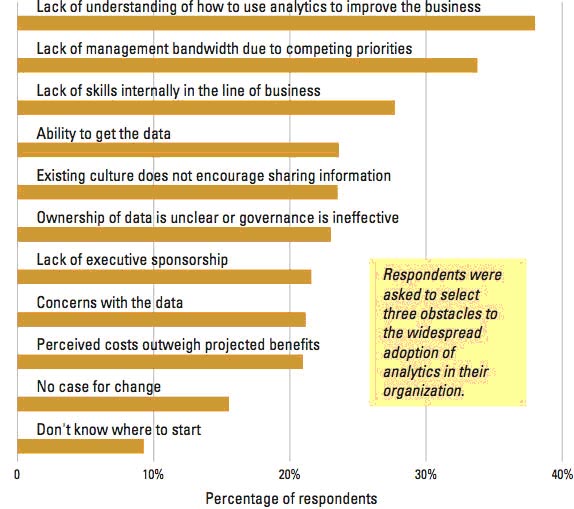
Obstacles for Adopting Analytics?

Organizations are struggling to understand how analytics can help them improve business results — and managers don’t even feel they have the time to figure it out. There are also cultural impediments around the organizational ownership and sharing of data. One interesting data point here is the perceived lack of skills. Our initial findings suggest that many organizations may have unrecognized talents within their midst — employees who consider themselves at least proficient in the use of analytics, but who are only occasionally asked to use them — especially in low-performing organizations.


Observations by MIT (Ref# 5)

References
Ref:
  1. Harvard Business Review Webinars - Analytics at Work: How to Make Better Decisions and Get Better Results http://blogs.hbr.org/events/HBR_Webinar_Davenport_Feb_2_10.pdf
  2. http://www.spss.com/predictive_analytics/work.htm
  3. http://itmanagement.earthweb.com/entdev/article.php/3900786/Study-Firms-Lack-Business-Analytics-Benefits.htm
  4. https://microsite.accenture.com/analyticsatwork/Documents/Accenture_analytics_at_work.pdf
  5. http://sloanreview.mit.edu/the-magazine/articles/2010/fall/521150/10-data-points-information-and-analytics-at-work/

Tuesday, March 27, 2018

Productivity Improvement

Productivity improvement is to get the piece of the cheese without being trapped. It is really a challenge, but not impossible. China could do it, why can’t we?
Today’s tough competition requires shorter delivery period, innovative and customizable products, higher quality and performance at much lower cost. We need to improve productivity of our organization to accept the challenge. The Improvement in productivity means a change. The change will be in processes, thinking as well as in policies. ‘Workforce adaptation to new technology’ and ‘resistance to organizational change’ are the biggest hurdles to overcome.
While taking productivity improvement steps, we need to answer three questions
  • Why to improve
  • What to improve & what to improve to
  • How to improve

If we are clear on these basic questions, improvement is easy.
In our daily life, we come across many difficulties or problems which affect our productivity. We tend to look in to the problems in isolation & try to find solutions temporarily. The solutions are ‘compromise’ between two apparently conflicting needs. By working this way, we are just postponing the problem. The problem will re-appear in some other form. We need to eliminate the ‘Root Cause’ of the problem.
Some times we are comfortable with current way of working. We compare with our industry standards and find ourselves in average productivity band. But if we wish to lead the market, or at least sustain in a long run, we must keep our productivity above our industry standards. That means we must be creative enough to do better than others. Theory Of Constraints  Thinking Process (TOC-TP) gives us tools to keep us far above industry standards.
Any system (organization) is made up of many elements like departments or business units. They are connected to each other by some causal relationship. Any integrated system like this always has a few (4 or 5 maximum) leverage points. Performance of the system can be manipulated up to large extent by fine tuning the leverage points like a radio. The real skill is to locate the leverage points & tune them to increase performance of the whole system.  It is not just technological challenge. Paradigm shift is the major hurdle to overcome. TOC-TP provides tools to locate the leverage points & manipulate the system. Many large, medium & small companies are using TOC & improved their performance (for example 70% reduction in inventory etc.)
We have seen management philosophy like Six sigma, Lean, TQM, TPM etc. have improved our performance in the past. But all these methodologies try to improve performance of our system everywhere. That gives results, but with high cost. Our systems are like chains. The weakest link in the chain determines strength of the chain. If you strengthen only the weakest link, the strength of the whole chain increases. TOC-TP focuses on weak links & strengthens the same. You will then apply Six Sigma, Lean, TQM etc only to the weak links & improve performance of your system with less investment.
TOC-TP is the latest management philosophy, which breaks all your paradigms & improves your productivity with very low or nil additional investment.

Santosh Karkhanis
TOCICO Certified Registered TOC Thinking Process Practitioner.